
MVAT: Multi-View Aware Teacher for Weakly Supervised 3D Object Detection
Published in WACV, 2026
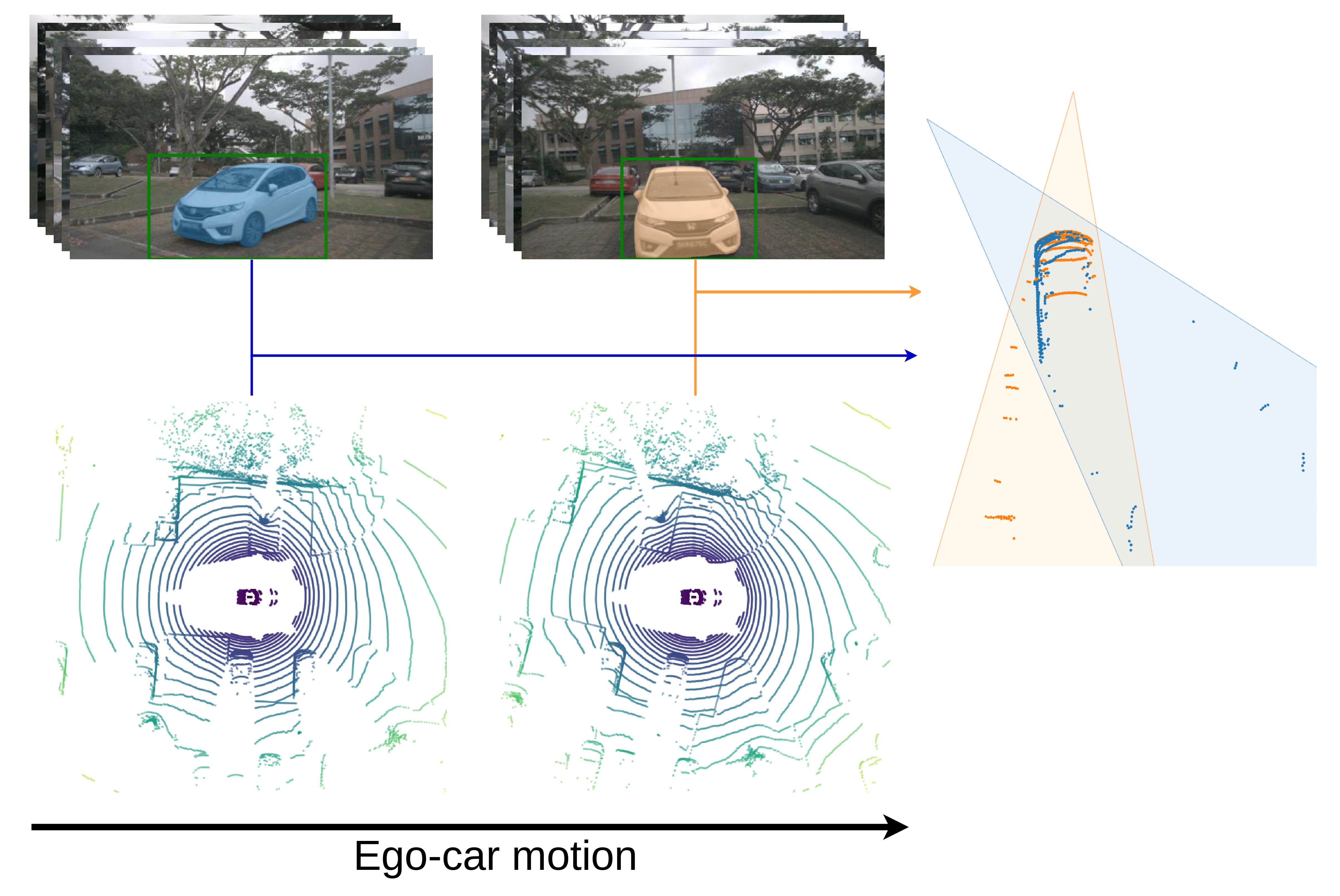 MVAT introduces a novel approach to weakly supervised 3D detection by tackling projection ambiguity. It presents a Teacher-Student framework that is the first to leverage the natural multi-view consistency from a moving ego-vehicle to resolve the inherent ambiguity of 2D annotations. The method proposes a robust technique to generate dense, high-quality 3D object representations and pseudo-labels by aggregating sparse point clouds over time, guided only by 2D bounding boxes. This process is further strengthened by a multi-view 2D projection loss that serves as a powerful supervisory signal, enforcing that a single predicted 3D box must align with all of its corresponding 2D annotations across the entire temporal sequence.

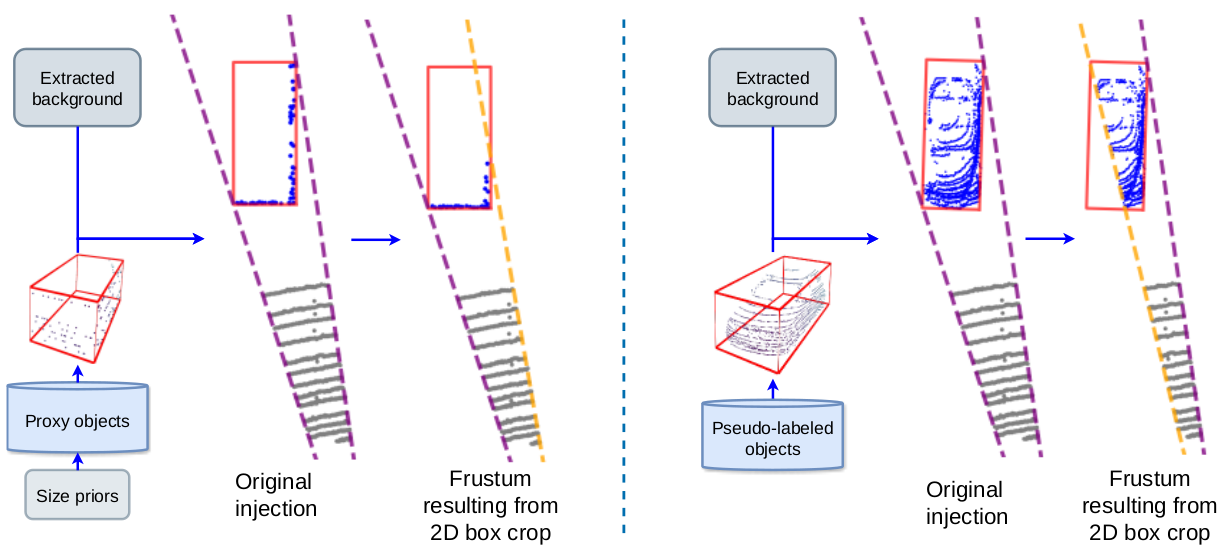 Training 3D object detectors is notoriously constrained by the cost of manual 3D annotation. While using 2D boxes is a cheap alternative, it introduces a fundamental problem: how can a model learn to predict a 3D box if it has never seen one? Our work, ALPI, resolves this paradox by introducing proxy injection: we synthetically create and inject perfectly-labeled 3D proxy objects directly into the point cloud during training. These proxies, built from simple class size priors, provide the unambiguous 3D supervision needed to bootstrap the learning process, enabling the model to correctly infer the 3D poses of real-world objects using only their 2D box projections.
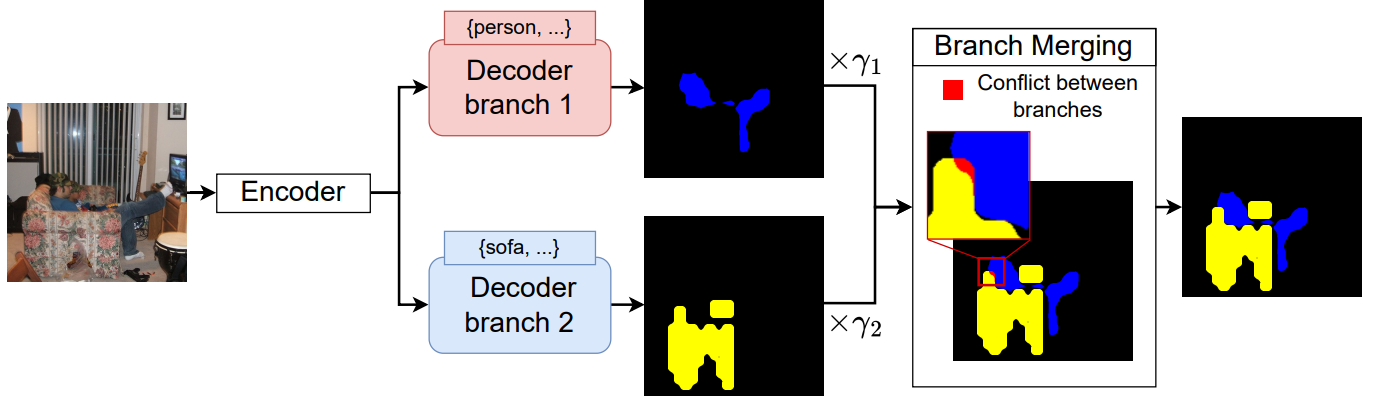 Incrementally learning new semantic concepts while retaining existing information is fundamental for several real-world applications. Although the impact of backbone size and architectural choices has been extensively studied in non-incremental computer vision tasks for efficiency concerns, class-incremental semantic segmentation models have so far focused primarily on large backbones, without offering a fair comparison in terms of model size. In this work, we propose a fairer study across existing class-incremental semantic segmentation methods, focusing on the models efficiency with respect to their memory footprint. Moreover, we propose TILES (Transformer-based Incremental Learning for Expanding Segmenter), a novel approach exploiting small-size ViT backbones efficiency to offer an alternative solution where severe memory constraints are applied. It is based on expanding the architecture with the increments, allowing to learn new tasks while retaining old knowledge within a limited memory footprint. Besides, in order to tackle the background semantic shift, we apply adaptive losses specific to the incremental branches, while balancing old and new knowledge. Furthermore, we exploit the confidence of each incremental task to propose an efficient branch merging strategy. TILES outperforms several previous methods on various challenging benchmarks while using up to 14 times fewer parameters.